Creating Change: Pinkwashing ICE, Pinkwashing Israel

On January 12, the National Gay and Lesbian Task Force issued an apology for including a panel by Immigration and Customs Enforcement (ICE) in the program of the upcoming Creating Change Conference. Familia: Trans Queer Liberation Movement, an organization that fiercely opposes the violence of immigration enforcement and has been part of the inspiring national #Not1More anti-deportation campaign, issued a response to the NGLTF apology: Apology Not Accepted.  Familia refused NGLTF’s weak acknowledgement after the uproar that ICE’s inclusion in the conference had caused. The problem with ICE being on the Creating Change program is not just that it makes people feel unsafe (it is a no-brainer that you shouldn’t invite ICE to events where you want immigrant activists to be able to participate), it’s that ICE is a massive source of violence in the lives of queer and trans people and an institution that queer and trans activists are trying to end. Inviting ICE to participate in the conference suggests that there is some kind of collaboration sought, or that ICE can show up and be “LGBT-friendly.”  Familia called out the reality that by including ICE, NGLTF ignored and rejected the clear anti-deportation, anti-immigration enforcement politics and strategy that has been articulated by queer and trans immigrant activists.  We are not fighting for a gay-friendly border, a gay-friendly immigration prison or immigration raid. The only way for queer and trans immigrants to be safe is if raids, detentions, deportations and everything else ICE does ends.

There is another controversy brewing on the Creating Change program that presents a similar dynamic.  The Israel advocacy organization, A Wider Bridge, is hosting a shabbat service and reception at Creating Change.  A Wider Bridge aims to connect LGBT people in the US with Israel and promote the image of Israel as an LGBT tourism destination. It coordinates tours funded by the Israeli Consulate bringing LGBT Israelis to the US to talk about gay politics in Israel, it hosted a conference with many US LGBT leaders last summer in Israel and had those leaders participate in Gay Pride in Tel Aviv, it promotes Israeli-government funded films that portray Israel as a haven for gay rights in which Palestinians seek refuge, and it brings tours of LGBT people from the US to Israel.  Its website proudly announces that it “led the LGBT contingent in New York’s Celebrate Israel Parade, and . . . marched with the Israeli Consulate in the New York Pride Parade.”

Queer and trans activists who are working to oppose Israeli colonialism and apartheid call this propaganda work “pinkwashing.”  For over a decade, the Israeli government has been engaged the “Brand Israel” campaign, aimed to respond to the growing movement against apartheid in Israel by portraying Israel as “relevant and modern.”  An important part of this effort has been to promote Israel as a gay-friendly country, touting the fact that gay people are allowed to serve in its brutal military and promoting Israel as a gay tourism destination.  This message relies on Islamophobia and anti-Arab racism as Israel contrasts its supposed “gay-friendliness” with stereotypes of its homophobic neighbors, particularly portraying Palestinians as homophobic. Queer and trans activists around the world who oppose occupation and apartheid have called this propaganda strategy “pinkwashing” because it is a direct effort to conceal the extreme violence and harm that Israel inflicts on Palestinians, including queer and trans Palestinians, by promoting Israel as “gay friendly.”

In 2012, activists in Seattle got to know A Wider Bridge and its pinkwashing activities very intimately when A Wider Bridge partnered with the homophobic, right-wing organization Stand WithUs to bring an Israeli Consulate-sponsored pinkwashing tour to Seattle. Queer and trans Seattle activists pushed back, exposed the propaganda and got a planned tour event at Seattle City Hall canceled. We faced a very unpleasant backlash and made a film about our story (which you can watch for free online).

We made this film in hopes that it will help queer and trans people and people who care about queer and trans people to read and interpret propaganda that tries to play on our movements’ messaging to build PR for  violent governments and institutions.  Clearly, the organizers of Creating Change need some help with this–ICE and A Wider Bridge ended up on the program because they packaged themselves as dialoguing about LGBT issues.  This is the new normal–police departments, prisons, the military, immigration enforcement and politicians and nefarious governments are all branding themselves as progressive, liberal and right-on with talking points about LGBT inclusion, meanwhile continuing their murderous work that  harms queer and trans people and cannot be aligned with our liberation.  When left movements across the US are calling attention to the racist violence of the immigration and criminal punishment systems, when more and more organizations are adopting resolutions to boycott and divest from Israel and the prison industry, queer and trans organizations have to get sharp about not becoming fig leaves or propaganda sites for institutions scrambling to prop up their tarnished images as their violence is exposed.

[Image by Micah Bazant]
[Image by Micah Bazant]

My regret about our film, Pinkwashing Exposed: Seattle Fights Back! is that we did not focus enough on A Wider Bridge. At the time, it made sense to focus on how Stand With Us co-coordinated the events, because they are such an obvious right wing Israel advocacy organization which an insincere interest in queer issues that is only about the propaganda opportunities for Israel. It seemed like focusing on Stand With Us made the pinkwashing more obvious. In the months that followed the completion of the film, it became clear to me that we should have also focused on A Wider Bridge, whose pinkwashing strategy is more insidious. Many people who would be suspicious of explicit Israel advocacy because they have some vague sense that Palestinians are suffering under occupation are swept up in the friendly images of gay Israelis sharing their experiences and inviting people from the US to visit.  Many people who know nothing about the occupation are learning about Israel from an Israel propaganda organization and not realizing it because it seems like a gay organization. A Wider Bridge denies that it is engaged in pinkwashing, but there is nothing secret about it being an Israel advocacy organization. It is not an organization focused on LGBT Jews, or an organization focused on LGBT Israelis, it is an organization focused on linking LGBT people in the US to Israel, the settler colonial nation engaged in apartheid, condemned by the world.  It is an organization whose promotion of Israel is designed to make people think of Israel as a site of liberation and freedom rather than a regime producing colonization and genocide. As a Jewish trans activist who has sometimes attended Creating Change over the years, I like the idea of having a Shabbat service at the conference, but I do not want Creating Change to invite any Israel advocacy organization to lead it or host programming focused on promoting propaganda about Israel.

I believe that the organizers of Creating Change intend for the conference to be a place of progressive queer and trans politics–they would not want it sponsored by Wal-Mart, featuring workshops by gay climate change deniers, celebrating the leadership of gay conservatives. Over the years, there have been many, many controversies in which activists have called out the failures of the conference to live up to its progressive aims–most frequently regarding issues that impact queer and trans people of color.  That is an important process and the work that activists have done to raise hell at Creating Change has forging new collaborations, changed queer and trans politics, and even changing the conference in some ways. Pinkwashing is now a ubiquitous and effective strategy for harmful institutions to promote a false image of themselves, and queer and trans activists have to sharpen our ability to discern it and hold organizations like NGLTF that purport to cultivate queer and trans liberation accountable when they partner with pinkwashers.  The organizers who exposed the ICE participation in Creating Change won an important victory over pinkwashing by getting ICE taken off the program. Now NGLTF needs to take an active role in preventing pinkwashing of Israel at this year’s conference.

creating-change-creating-chains-2
[Image from leaflet handed out by Gay Shame activists at Creating Change 2005 in Oakland.]

Reviews, news, interviews

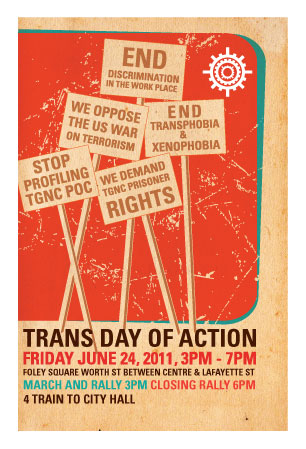
Thanks to Dan Irving for a generous review of Normal Life in GLQ and to Rachel Levitt for this review of Normal Life in the inaugural issue of QED: A Journal in GLBTQ Worldmaking.  I also want to share a new interview that just came out at the Youngist. And finally, thanks to Jordan Flaherty for this excellent Al Jazeera America story about police profiling of trans people. I can’t figure out how to embed the video here so I’m sharing this image of a Trans Day of Action poster that I love instead.


Blog Post for Upcoming Conference

This coming Friday and Saturday I’m heading to Los Angeles for a conference that marks the 40th anniversary of Roe v. Wade and the 10th anniversary of Lawrence v. Texas.  In advance of the conference, speakers were asked to write blog posts related to the themes of the conference panels we are participating in.  These were posted to the Balkinization blog. I thought I’d re-post what I wrote here as well:

Sexual freedom, legal equality and settler colonialism

In recent weeks, the world has been captivated by the emergence of the Idle No More movement. Indigenous people and their allies in Canada and around the world have been engaging in a wave of protest actions.  These protests, which include marches, vigils, road blocks, railway blocks, flashmobs and the prominent hunger strike of Chief Theresa Spence of Attawapiskat, are raising a number of significant issues.  Initially, the movement was a response to the Harper government’s introduction of Bill C-45, legislation that would significantly weaken environmental protection laws in Canada.  As the movement has grown, its message has broadened to raise questions about indigenous sovereignty and environmental protection more generally, both in Canada and around the world where indigenous people struggle against colonization and environmental degradation.
Movements against colonization raise significant questions for scholars studying the legal regulation of sexuality and family.  The imposition of gender norms and family formation norms and the use of sexual violence as a tool of war have been significant to processes of colonization.  The depiction of cultures and peoples targeted for colonization as “backward” in terms of sexuality and family formation has been a rationalization for colonization, and has often included portraying indigenous women as needing to be saved by the colonizers from their own families and cultures.  These methods and rationalizations are visible in the history of the colonization of North America where the Idle No More movement has been most visible so far, but we can also hear these rationales deployed to justify the war in Afghanistan, proposed war with Iran, and in rationales for Israeli settler colonialism in Palestine.
These dynamics are particularly interesting in the context of a contemporary gay and lesbian rights framework in the US and its global influence.  As many scholars have noted, the gay and lesbian rights framework has increasingly moved toward demands for formal legal equality in recent decades, particularly focusing on demands for military participation and access to legal marriage. There has been a great deal of critique of these demands by a range of feminist, anti-racist, queer and trans scholars.  One aspect of this critique that is particularly interesting in the context of the Idle No More movement’s growing momentum is how these demands speak or fail to speak to the quest for sexual freedom for those imagining freedom from an anti-colonial perspective.
Ostensibly, the contemporary gay and lesbian rights agenda developed from the sexual liberation movements of the 1960’s and ‘70’s that are remembered in images from the Stonewall Riots where queer and trans people fought back against police harassment and criminalization.  As it developed, its vision of “freedom” has become more aligned with joining the apparatuses of colonial occupation than fighting them. The US military literally operationalizes US colonial and imperial violence, and marriage enforces the family formation norms for the settler colonial state by disbursing essential benefits to the population based on whether we conform to that norm.  As the Idle No More movement and other anti-colonial movements such as the Boycott, Divestment and Sanctions movement continue to grow, queer and trans politics faces interesting questions about how various approaches to conceptualizing sexual freedom relate to anti-colonial agendas that seek to dismantle the apparatuses in which certain lesbian and gay rights campaigns and court cases seek gay and lesbian inclusion. These questions are particularly interesting now, as gay and lesbian people are increasingly articulated as those that need saving in colonial discourses.  Access to legal marriage and military participation for gays and lesbians are now often used as measuring sticks for whether or not a country respects human rights, and human rights enforcement rationalizations are a popular justification for military intervention.  The Idle No More movement’s emergence in this moment provides an opportunity for reflection on the relationship between commitments to sexual freedom and commitments to self-determination and decolonization.
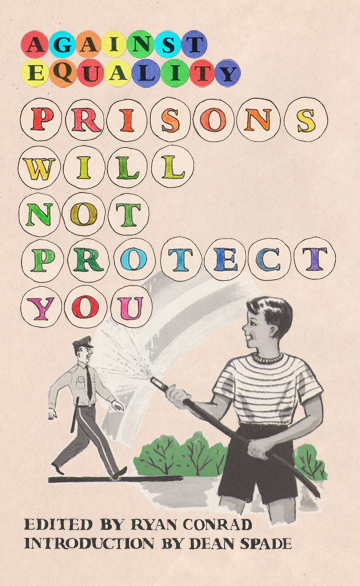
Can You Hear Me Now? co-authored with Colby Lenz

Colby Lenz and I co-authored this article “Can You Hear Me Now?” originally published by CommunityChange.org. Read the full-text below. 


Can You Hear Me Now?

By Colby Lenz and Dean Spade

Many of us share a set of concerns or complaints about cell phones. You hear them all the time. Nobody makes plan anymore ahead of time. People talk on cell phones everywhere instead of looking around and being present. The constant noise of cell phone use is annoying and often rude and inappropriate. Cell phones (including those with email) encourage people to work more, losing any sense of work-life balance.

These are solid, important complaints and we have more concerns about cell phones that we want to add to the list. We hope to re-frame the conversation about this suddenly ubiquitous technology in a broader and more urgent context. Here are six problems to consider:

  1. Cell phones are just a new consumer luxury item masquerading as a need. A little over a decade ago we all lived life without them. We survived flat tires, street protests, non-profit jobs, family illness and our social lives without Blackberries and Razrs. Cellphones represent a new level of privatization of phone service. Along with other ways we have punished the poor, pay phones are now on the decline, making access to phones more difficult for people without cash or credit. We have moved from sharing phones (party-lines), to household lines, to individual lines. This means more money for big business. What does it mean that so many people committed to a more socialized politics are giving so much money to the telecommunications industry? What else might we do with that money if we let go of these private status symbols and shared phones like we used to?
  2. If everyone else held a piece of plastic filled with cancer-causing chips next to their head all day long would you? Our friends who use cell phones tell us their ears hurt. Studies worldwide suggest cell phones are linked to brain cancer, research that the phone industry works its magic to quiet or stop. We know very well that we cannot trust big business with our health and the health of our loved ones. What’s convenient now might be very painful later. We want you to live and be well.
  3. Cell phones don’t grow on trees. They are made of plastic, are “disposable” (meaning made to break and be lost) and millions of them are thrown into landfills every week. Coltan, a key material that makes them work, is mined in the Congo under horrendous conditions, resulting in an estimated 3.2 million deaths since 1998, deforestation of the region and birth defects from water contamination. Like all other consumer goods, the people who use and enjoy this luxury are mostly clueless about the extreme exploitation and violence required to create them.
  4. Bees are the key to our food and our survival. Recent studies found that commercial bee populations suddenly declined 60-70% in the US and scientists theorize cell phone signals as a very possible cause. Scientists have proven that power lines can affect bee behavior and destroy hives and the sudden increase in hive death from cell phone signals may seriously endanger plant life and food sources for bees. While mass-produced crops like wheat and corn are pollinated by wind, some 90 cultivated flowering crops rely mostly on honeybees. According to a Cornell University study, honeybees pollinate every third bite of food ingested by Americans.
  5. Cell phones are recording devices used to criminalize people. Buying and using cellphones supports surveillance culture and promotes state violence. Not only can every one of your conversations (whether your phone is next to your ear or off in your bag) be heard and recorded by the telecommunications industry and the state, it can also be used as evidence against you and anyone you speak to. And even if you personally are not targeted, your cell phone dollars support policing, surveillance and imprisonment of criminalized classes of poor people and people of color.
  6. Scarcity and insecurity starts at home. The emotional economy of cell phones also concerns us. Capitalism makes us feel insecure and competitive for seemingly scarce resources. The same drive to consumerism and buying cell phones is the same emotional context of fear that drives war. This national-personal insecurity matrix is visible when people buy cell phones because they’re afraid of getting in an accident or being a crime victim and needing to reach the police. It is visible when people feel they have to have a cell phone for their job, to feel professionally important. It is visible when people fear that if they don’t have one, then their friends will stop calling them and they will be disconnected from social life. It feeds capitalist imperatives: every desire must be met immediately and we must always be working and striving and climbing (socially, professionally, etc.) without rest. The mindset of the cell phone is part of our brutal economy.

But why single out cell phones for these concerns? Many other products harm the environment and mobilize our minds, bodies and social connections in the interest capital. So many products have negative health impacts and so many can be used as tools of state terror. Cell phones are not unique these ways. But what concerns us is the uncritical embrace of cell phones, especially by people on the left and self-proclaimed anti-capitalist activists. While we have an ongoing critique of cars and real estate and sweatshop-produced clothing and many other things, this gigantic, new and extremely pervasive shift in consumption goes almost un-critiqued in terms of these ramifications.

This is a call for an analysis of the operation of this technology and the telecommunications market, using all the critical skills that radical activists have developed. This is an invitation to join us and get rid of your cell phone — or don’t get one in the first place. Help us resist the allures of this technology and support each other in remembering other ways to communicate, organize and connect with one another. Like all of our other endeavors to create a better world, this is not about perfection. We are all caught in this economy, engaging in consumer practices that are harmful, but we can still identify and act on the concentrations. It is more than possible to live without a cell phone – some of us find life way better without them.


Read more like this at Enough: The Personal Politics of Resisting Capitalism, a collaborative project with Roan Boucher.