Relationships Across Prison Walls (including open letter from Endjah)

My friend Endjah, who has been locked up for six years and is currently in a women’s state facility, wrote the text below addressing questions that often come up when people outside and inside prisons become friends. Endjah’s letter was prompted by a conversation with an outside organizer who coordinates with other people who are forming and sustaining relationships with people inside prisons, but it came on the heels of a series of conversations Endjah and I had about these questions. Some of these emerged from a project I have been working on with my podcast collaborators for a series of episodes about inside/outside relationships. The first one is out now, video above in this post. 

We also published this interview with Corey, who was just released after serving thirty years. In Corey’s interview, he advocates for people outside to be more open to the possibility of having romantic relationships with people inside. He talks about the stigma around such relationships, and also the ways that if someone inside raises the possibility, the outside friend often freaks out and cuts off contact rather than just saying they don’t want to move in that direction. Corey’s describes feeling like because the forced isolation caused by prison puts people in prison in a desperate situation regarding social contact, they often have to tread carefully, fearing they will alienate their outside friends if they make any mistakes or ask for too much. He is arguing for all of us–inside and outside–to be more direct, willing to ask for things that interest us and also willing to say no but stay connected. When I heard him describing these dynamics and making these suggestions about how we might all proceed, I thought a lot of it sounded relevant to relationships of all kinds, including between people who are not in prison. 

In any case, I am excited to share this intervention from Endjah and for us all to think together about how we might be more direct with one another, and more open to possibilities with one another. Talking to Corey and Endjah also helped me reflect on why, in the decades that I have been connecting with people in prison, forming and sustaining often long-term friendships, I have never had a romantic connection across the prison wall. In part I think that I haven’t met someone where that spark was present, but I also recognize that I have a deep fear that such a relationship might be somehow problematic because of the power dynamics. Those dynamics are so intense when I have freedom, access to information and money, virtually unlimited access to social outlets, and the other person has such extreme barriers in all areas of life. Since the interview with Corey, I’ve spoken with a few friends outside who have had romantic relationships with people inside, and they have shared the beauty of the connections as well as how difficult the constraints on the relationships were, and how much pressure the differences in circumstances put on the people in the relationship. It is so difficult to hold romance, very uneven interdependency, the insecurity that romance brings up for everyone, and the material barriers that the prison system creates. A couple people mentioned how many lonely people there are, inside and outside, and how sweet it would be if more people could connect and pay attention to each other across the prison walls, how much love could be exchanged, even if only by mail and phone calls. I think that is true, and wonder what kinds of relational skills we could all build so that more of that love could be exchanged. One starting point has to be just that more people have relationships of any kind across the walls. Making all people in prison less isolated would improve all of their relationships inside and outside, and make them safer in material ways. I hope that people outside who read Endjah’s letter and listen to Corey’s interview might, first off, consider increasing their relationships with people inside. Secondly, I hope they will consider being as direct and authentic in those relationships as possible, including to being open to whatever unfolds with their friends inside, telling people yes and no directly, staying connected even when there are conflicting desires or other kinds of tension and turbulence.

Letter from Endjah:

Dear Ones,

A lot of us have been having conversations about big feelings and questions that can come up when captives reveal crushes on or flirtatious interests toward pen pals on the outside. Some common reactions are emerging that make a lot of sense, but aren’t necessarily reflective of the values we all want to be living.

  • Some folks are finding themselves feeling a strong, urgent desire to set outsized boundaries that are disproportionate and likely to shut down hard won trust or feelings of safety.
  • Some folks are feeling stuck or frozen, leaving the person on the inside anxiously awaiting a reply and forced to interpret the silence in ways that are likely to be harmful by default.
  • Some folks feel compelled to look up their admirer’s charge(s), even if that had felt against their personal ethics beforehand.
  • Some folks feel a reflex to end the connection, sending the message that full expression of humanity or complexity of any kind is unacceptable in inside/outside relationships.
  • Some folks feel interested, but concerned about how the power imbalance that is inherent in all inside/outside connections could be magnified if they enter into a flirtation or romance.
  • Some folks feel unsure about whether or not they’re interested because they’re not sure what an inside/outside romance could look like if it developed over time.

To live abolition, it is imperative that we give ourselves grace while we navigate hostile landscapes that can play tricks with our minds and emotions. This is particularly true when it comes to matters of the heart. Our beloved Dean has written an entire book about how disorienting romance can be in these complex times. It can feel like the place where all of our intentional visioning and carefully cultivated integrity flies out the window, even when everyone is free.

The following is a list of gentle reminders – things we already know that can be easy to forget when romantic feelings get involved – and an offering that may help us move forward together.

Reminder #1 – We coexist with cultural structures that employ human trafficking as a tool for profiteering and social control. When we keep this in mind, it’s easier to remember that convictions (including pleas) are reflections of racial capitalism and should not be deferred to as measures of character or worth. As abolitionists, we are clear about these matters, but our bodies are inundated with sensationalist messaging that seeps in. It can cause us to have emotional reactions that aren’t in line with our values.

Reminder #2 – There is nothing inherently scary, wrong, or bad about someone on the inside initiating a flirtation or expressing that they have developed romantic feelings for someone who has been writing them from the outside. Humans have feelings, and sometimes those feelings are romantic.

Reminder #3 – Carceral structures deprive captives of safe or spacious physical contact, expressions of affection, emotional support, sexual intimacy, and myriad other basic needs. It makes perfect sense that human bodies and minds – in their incredible, creative capacities for resilience – will amplify any forms of care that are received to maximize their healing and soothing effects.

As a result, it’s extremely common for folks on the inside to develop crushes on pen pals or to seek out romance or flirtation through correspondence as a means of basic survival. When we are reminded that we are property by every aspect of our immediate environment, any potential path that might feel affirming and humanizing feels worth exploring.

An Offering – I created the following template for a friend who hosts letter writing parties. I’m sharing it here with the hope that it can be adapted as anyone wishes to fit with one’s personal tone and specific situation. The template is intended to be nestled inside a longer letter, in order to reinforce that the person on the outside is not trying to end the connection and that they want to keep building. The first paragraph is intended to introduce the topic. The second and third paragraphs are alternate options, depending on the vibe of the writer and what they are wanting.

.…In your last letter, you called me X (or you expressed Y). I wanted to check in about what this kind of endearment (or expression of affection) means to you. For me, that’s a phrase that I would reserve for someone I am dating. It could mean something different for you, but I wanted to ask because it can be hard to interpret tone in written communication and I want us to be on the same page.

I want to be responsible in the relationship we are building by sharing that I am not available for a flirtation or a romantic connection right now, but I’m excited to continue our conversations about…

OR

I don’t know if you were trying to initiate a flirtation in your last message. I feel open to exploring that if you are, and I also feel great about continuing our conversations without any flirtation if your phrasing was intended to be friendly in nature…

I hope this language is helpful! Please feel free to share/adapt/add/etc. as you wish!

With infinite love, gratitude, and abundance,

Endjah

This Valentine’s Day, Let’s Ditch Romance Myths and Seek Collective Liberation

It’s the first Valentine’s Day in the second Trump presidency, and the speed-up of racist, ecocidal, patriarchal, wealth-concentrating terror is ploughing through, leaving devastation, despair and overwhelm in its wake. In courageous pursuit of love for our people, in profound solidarity with life on the planet, it’s time to shrug off the patriarchal romance myth and the ways it domesticates our freedom dreams, demobilizes our disobedience, and isolates us from the very people and pleasures that can make life worth living.

Valentine’s Day is a mainstay of the romance myth, insisting we celebrate romance or feel left out. It asserts that romantic relationships are the most important, that our lives are empty without them, and that we should sacrifice all to get and keep them. This myth is an important part of the social control that keeps patriarchy and racial capitalism going.

Regulating people through the government-approved family form has been essential to colonial projects of land theft and enslavement, border enforcement, military conscription, and the creation of racialized-gendered welfare systems that quell rebellion and stigmatize poverty. The romance myth is crucial for maintaining a gendered division of labor and extracting unpaid reproductive labor from women.

Romance myth propaganda in songs, shows, romance novels and social media keeps us psychically tethered to a belief that romantic love and marriage will provide emotional and material security. It demands that we jealously compete for the ideal mate (and housing and job), obsess over our worthiness, and devote time and energy to meeting societal norms — all of which undermines our solidarity and collectivity.

Generations of feminists have exposed marriage and romance as structures built to confine and control women and children and maintain the racial order, and also encouraged us to tap into the erotic as power. Feminist and queer resistance reminds us of the wild creativity and aliveness, the feral pleasures of our bodies and generous connections across friendship, lovers, chosen family and our collectives. The methods by which the erotic is domesticated are truly heartbreaking.

We are offered unsatisfying prizes in exchange for our wildness: sexless yet “secure” relationships, jealousy, unsustainable domestic labor and child care arrangements, products to decorate our cages — and self-blame for our unhappiness. Meanwhile, the person most likely to hurt or kill you is a date, family member or partner.

Amid a pressing acceleration of harm and violence (ecological crisis, wealth concentration, immigration enforcement, criminalization, attacks on queer and trans people and reproductive care, genocidal and imperialist warfare) our resistance movements are often disorganized by the romance myth. People tend to wreak havoc on lovers, groups and communities when caught up in romance myth scripts and reactions. Our groups implode because we don’t know how to stick together when we are overcome by the fear, insecurity, distrust and disappointment that are bound to arise when people gather to do anything that matters to them. And our lack of skillful attention to relational and group dynamics frequently turns off newcomers, leaving our efforts too small for the immense work that is needed.

We often pretend it doesn’t matter how we treat each other as long as we get the deliverables out: meals distributed, banners dropped, court cases filed, actions planned. Yet as feminists have always maintained, the personal is political, and the “women’s work” of attending to relationships is vital. Many brilliant organizers (or former organizers) who identify as “burnt out” aren’t tired simply from the hard work of collective action but from unresolved conflict with other organizers that no one had the skills to address.

Even people who somehow had maintained hope in liberalism, the Democrats and the trappings of neoliberal multiculturalism until the 2024 election are now encountering disillusionment. The dangerous fantasy that the United States government is going to solve the problems it creates and perpetuates is crumbling. Let it go! Now, how do we welcome newly awakening and despairing people into our movements, including those coming back after the isolation of burnout? How do we create onramps to mobilization that help people start from whatever they are initially pissed off about and expand their solidarities to care for more and more people, to understand the links between their own lives and everyone’s?

We can start with recognizing how isolated people in our society are. More of us live alone than ever, and report having no one to share good and bad news with. So when people take the risk to find us, we need to welcome them, knowing that they are seeking belonging and connection alongside purposeful action. Our groups shouldn’t feel like workplaces where we push ourselves and each other, sacrificing relationships to get the next task done. This isn’t a short-term situation. The rest of our lives will be unfolding, worsening disasters caused by ecological crisis and the unravelling of U.S. empire. The success of each action must be measured on whether, when it was over, we are more prepared to take bold action together, more connected to one another, more trusting and trustworthy.

My assessment, 25 years into resistance work, is that right now all it takes is one strongly emotionally activated person to disorganize almost any group. A string of smaller unresolved conflicts precede the moment of blowup and break down. The romance cycle is present in our groups just as in sexual relationships and friendships. We often project at the start that this person or group is going to meet deep unmet needs, that we’ve found “the one,” and we selectively ignore signals that conflict with our rosy view. Inevitably, at some point, disappointment arrives and now we tear down our beloved — our devastation proportional to the height of the pedestal we had previously placed them on.

How do we create groups that can stay together, anticipate this cycle, hold each other even when someone gets stirred up and goes into attack mode? How do we stay connected through strong feelings, sticking to our principles of repair rather than wreaking havoc? How do we hold ourselves with care and remember our shared purpose when we are gripped by strong reactions and spinning out, especially given that we often find a political rationale for our emotional reactions?

Conditions are worsening so rapidly, and we need to be steady and prepared to take bold action together, to care for each other, and to fight back. As Kelly Hayes has written with such clarity, we need to develop a much more robust underground in this time, so that we can make and distribute our own medicines, protect each other from the police and immigration enforcement, take aim at the infrastructure aimed at our people and the planet, and claw back what we need to survive. We are, and will be, working under escalating pressures of grief and loss, political repression and harsher conditions of immiseration. We need resistance groups where people listen to each other rather than bossing each other around, and invite feedback and critique rather than silencing each other or being afraid to express important concerns. We need to know how to bring new people in and help them get deep into the work and become co-stewards, not just envelope-stuffers. As Toni Cade Bambara invited us, we can and must “make revolution irresistible.”

To do all this, we must individually examine which romantic fantasies are holding us back. How do fantasies of bourgeois nuclear family domesticity keep us from collectivizing our housing, cooking, child care and elder care? Could we live more collectively to save our time and resources so we can dedicate ourselves further to movement work? How do ideas about careerism and status rein in the radical possibilities of our life’s work? What if we understood that all the most important work we’ll ever do will be unpaid, autonomous from governments, corporations and philanthropists? What kinds of work would we do then, and how would we organize our survival to maximize time away from paid work?

How do romance myth fantasies about sex and love distort our expectations, get in the way of clear communication and consent, and undermine our friendships and radical collaborations? What if we recognized the strong feelings that can come up — jealousy, envy, possessiveness, fear of rejection, fear of abandonment, fear of engulfment — and cared for ourselves in them, while working to not to let them determine our actions in relationships?

What if we worked with our friends and comrades to cultivate shared principles for generosity, courage, autonomy and connection, as well as tactics for how to practice those even though racial capitalism and patriarchy have filled our psyches with damaging reactivity?

Caring for each other and the world around us has been the daily task of our species from time immemorial. And it’s more urgent now than ever. Our opponents have almost all the money and guns. All we have is almost all the people. We have to learn to take action together, to care for each other in life-threatening circumstances, and to fight back against deadly forces that currently dominate and endanger most life on earth. To survive, we can’t let our interpersonal conflicts fueled by romantic fantasies, or harmful habits of hierarchy and centralization inherited from the dominating systems (including schools, families, jobs and most religions) hold us back.

For Valentine’s Day in this frightening time, let’s dedicate ourselves to true love and liberation. May we all be free from romance myth brainwashing, free to love wildly and boldly, outside of domesticated expectations. May we fuel our rule-breaking with satisfying, invigorating sex and promiscuous friendship. May we become better able to love and care for strangers and even people we don’t particularly like. May we find those who are lonely and bring them to the struggle to be loved and cared for with us.

New Book! Out January, Pre-Order Now

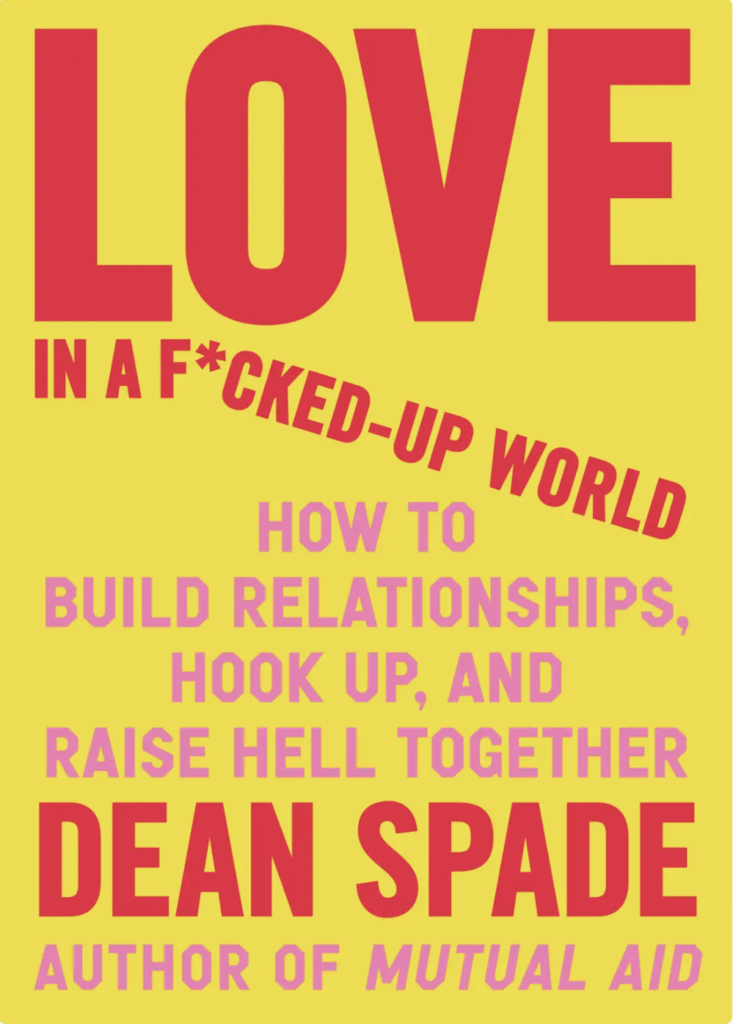
Cover image of Love in a F*cked Up World: How to Build Relationships, Hook Up, and Raise Hell, Together

My new book will be out January 14, 2025!

Around the globe, people are faced with spiraling crises, from the pandemic and climate change-induced disasters to the ongoing horrors of mass incarceration, genocide, racist policing, endemic gender violence, and severe wealth inequality. More and more of us feel mobilized to fight back, often dedicating our lives to  collective liberation. But even those of us who long for change seem to have trouble when it comes to interpersonal relationships. Too often we think of our political values as outward-facing positions again dominant systems of power.  Many projects and resistance groups fall apart because people treat each other poorly, trying desperately to live out the cultural myths about dating and relationships that we are fed from an early age. How do we divest from cultural programming that gives us harmful expectations about sex, dating, romance and friendship? How do we recover from the messed up dynamics we were trained in by childhood caregivers? How do we bring our best thinking about freedom into step with our desires for healing and connection? Love in a F*cked-Up World is a resounding call to action and a practical manifesto for how to combat cultural scripts and take our relationships into our own hands, so we can stick together while we work for survival and liberation. Pre-order through Bluestockings and get 15% off with the code F*CKED<3.

Click here to watch the webinars I did with Fireweed Collective over the last four Valentine’s Days about dismantling the romance myth, which capture some of the themes of the book.

Building Accountable Communities Video Series

Please watch and share this new video series featuring Shannon Perez-Darby, Kiyomi Fujikawa, and Mariame Kaba, produced by me and Hope Dector. 

Accountability is a familiar buzz-word in contemporary social movements, but what does it mean? How do we work toward it? What does it look like to be accountable to survivors without exiling or disposing those who do harm? We made four short videos featuring Kiyomi Fujikawa and Shannon Perez-Darby talking about these issues, and then recorded a live discussion between Shannon, Kiyomi, and Mariame exploring models for building accountable communities for the purpose of healing and repair. 

The online event:

Part 1: What is Accountability?

Part 2: What is Self-Accountability?

Continue reading “Building Accountable Communities Video Series”